000
AXNT20 KNHC 062109
TWDAT

Tropical Weather Discussion
NWS National Hurricane Center Miami FL
0015 UTC Tue Apr 7 2026

Tropical Weather Discussion for North America, Central America
Gulf of America, Caribbean Sea, northern sections of South
America, and Atlantic Ocean to the African coast from the
Equator to 31N. The following information is based on satellite
imagery, weather observations, radar and meteorological analysis.

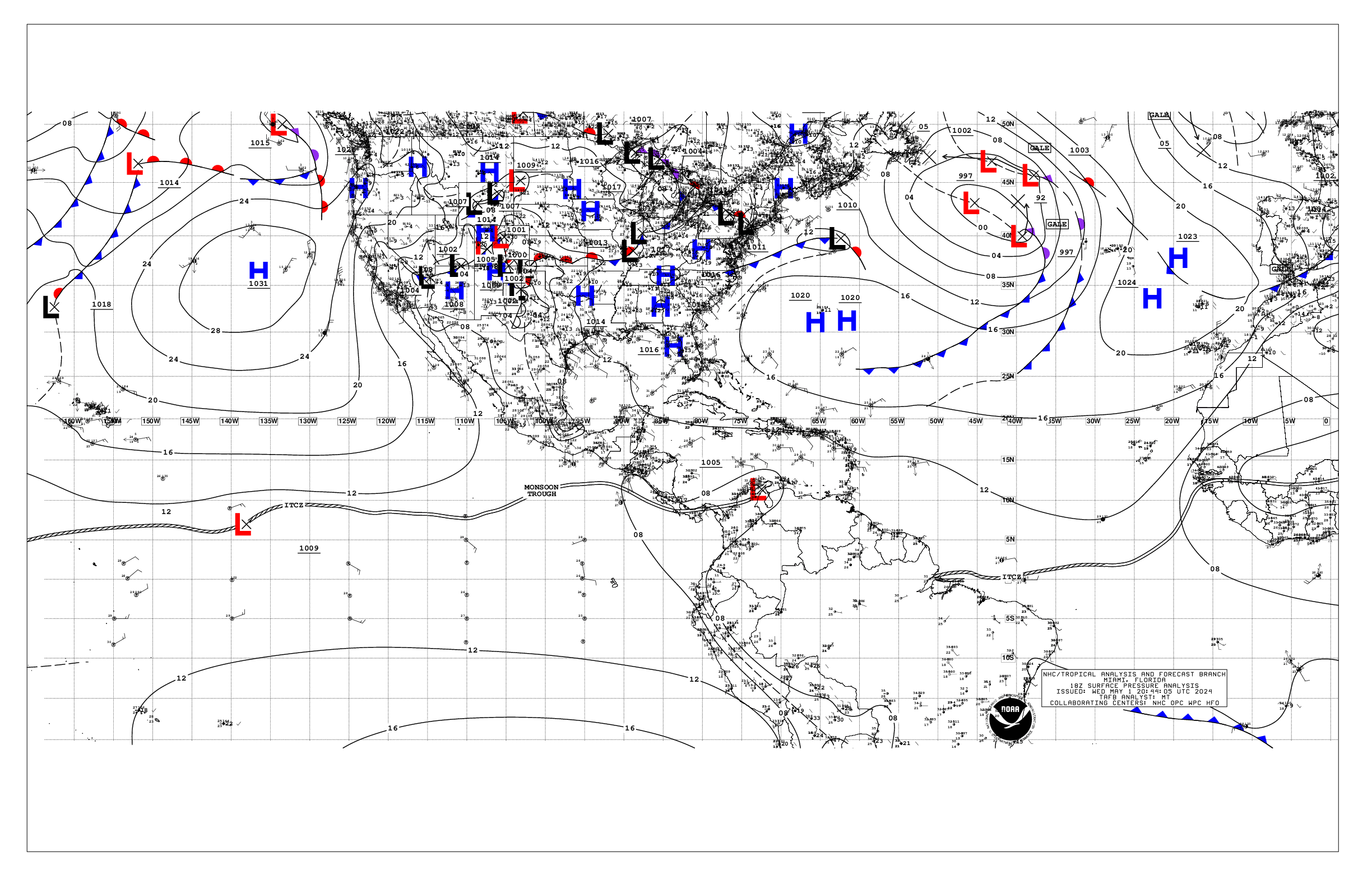
Based on 1800 UTC surface analysis and satellite imagery through
2000 UTC.

...SPECIAL FEATURES...

Atlantic Gale Warning: A cold front stretches from well offshore
the United States Mid-Atlantic region through 31N76W to near Cape
Canaveral, Florida. The cold front will move slowly SE and reach
from just N of Bermuda to near Palm Beach, FL by Wed morning. Low
pressure is forecast to form along the front in the vicinity of
the NW Bahamas on Tue, then move NE along the boundary and out of
the basin toward Bermuda by Thu. Strong high pressure building N
of the front will produce strong to near gale- force NE winds by
early Tue, then increase to gale-force midday Tue through at least
Wed night as the low pressure moves along the front. Very rough
seas in excess of 15 ft are likely in the area of gales, and will
linger N of the front through late Thu. The front is expected to
stall from near Bermuda to the Straits of Florida by Thu night and
gradually weaken into the weekend, with marine conditions to
slowly improve.

Gulf of America Gale Warning: A stationary front extends from
N-central Florida along 28.5N to 1013 mb low pres centered near
25N93W, then continues southward as a cold front to the central
Bay of Campeche to near Coatzacoalcos. Strong to near gale-force
winds will prevail N of the front into tonight, with gale- force
winds near Veracruz through this evening. Rough to very rough seas
will accompany these winds.

Please read the latest High Seas and Offshore Waters Forecasts
issued by the National Hurricane Center at website:
https://www.nhc.noaa.gov/text/MIAHSFAT2.shtml and
https://www.nhc.noaa.gov/marine/offshores.php for more information
on both Gale Warnings.

...MONSOON TROUGH/ITCZ...

The monsoon trough enters the Atlantic along the coast of Guinea
near Conakry, then reaches westward to 09N19W. Farther south, the
ITCZ extends west-southwestward from 02N15W to near the Amazon
River Delta area. Scattered moderate convection is noted from 01N
to 06N between 07N and 13W.

...GULF OF AMERICA...

Please refer to the Special Features above for details on a Gale
Warning in the SW Gulf of Mexico near Veracruz, Mexico.

Otherwise, scattered showers and isolated thunderstorms are
occurring from near and N of the stationary front across the
waters N of 24N and E of 92W per the latest infrared satellite
imagery. Scattered showers are found near and west of the cold
across the W-central and SW Gulf, including the western Bay of
Campeche. Fresh to strong NW to NE winds with seas of 6-12 ft
exist behind the stationary and cold front. In addition, winds
near Veracruz, Mexico are peaking at gale-force. S and E of the
fronts, gentle to locally moderate NE to E winds with 2-5 ft seas
prevail.

For the forecast, strong to near gale-force winds will prevail
N of the front into tonight, with gale-force winds near Veracruz
through this evening. The front will reach from near Sarasota,
Florida to the eastern Bay of Campeche by midday Tue, then move S
and across the Straits of Florida Wed through Thu, where it will
dissipate. The low pressure will shift E-NE along the front Tue
through Wed night to produce scattered thunderstorms with locally
gusty winds, and also produce strong NE winds across much of the
NE basin. Conditions will begin to improve Fri through Sat as high
pressure over the NE U.S builds southwestward across the northern
Gulf.

...CARIBBEAN SEA...

A fair and modest trade-wind regime continues across the entire
Caribbean Sea. Moderate to fresh E-SE trades with seas of 5-7 ft
are present in the central and eastern basin, locally to 8 ft near
Atlantic Passages. Gentle to moderate NNE to ENE winds and 2-5 ft
seas prevail for the rest of the Caribbean Sea. No significant
convection is noted over the offshore waters.

For the forecast, the pressure gradient between high pressure
across the N-central Atlantic and low pressure over South America
will continue to support fresh to locally strong E to SE winds
over the eastern half of the basin, S of 16N, through early Thu,
and gentle to moderate NE winds across the western portion. By
Thu, strong high pressure across the western Atlantic will build
southward toward the region to bring a return to more typical
fresh to strong winds across south-central portions offshore of
Colombia and NW Venezuela.

...ATLANTIC OCEAN...

Please refer to the Special Features above for details on a
developing Gale Warning in the SW N Atlantic.

A cold front is moving slowly SE across the northwestern zones
this afternoon, extending from 31N76W to near Daytona Beach, FL,
and Scattered showers and isolated thunderstorms are noted behind
this front. Fresh to strong NE winds and building seas of 6-8 ft
are noted behind the front. Coupling with convergent
southeasterly trade winds, scattered moderate convection is found
from 20N to 25N between 58W and 69W. In the east Atlantic,
another cold front reaches southwestward from northwest of Madeira
across 31N23W to near 28N42W. Scattered showers are seen up to 650
nm along either side of the front. Fresh to strong N-NE winds and
8-14 ft seas in northerly swells are found behind the front.
Mainly moderate to fresh trades dominate the remainder of the
waters S of 29N and E of 68W, with gentle to moderate return flow
W of 68W and E of the front off the United States. Seas are 5-7 ft
in mainly N-NE swells S of the eastern Atlantic front and E of
35W, and 6-9 ft elsewhere/westward.

For the forecast west of 55W, the cold front in the SW N Atlantic
will move slowly SE and reach from just N of Bermuda to near Palm
Beach, FL by Wed morning. Low pressure is forecast to form along
the front in the vicinity of the NW Bahamas on Tue, then move NE
along the boundary and out of the basin toward Bermuda by Thu.
Strong high pressure building N of the front will produce strong
to near gale- force NE winds by early Tue, then increase to gale-
force midday Tue through at least Wed night as the low pressure
moves along the front. Very rough seas in excess of 15 ft are
likely in the area of gales, and will linger N of the front
through late Thu. The front is expected to stall from near Bermuda
to the Straits of Florida by Thu night and gradually weaken into
the weekend, with marine conditions to slowly improve.

$$
Lewitsky


 NHC on Facebook
 NHC on X
 NHC on YouTube
 NHC Blog: