000
AXPZ20 KNHC 252212 CCA
TWDEP

Tropical Weather Discussion...Corrected
NWS National Hurricane Center Miami FL
2205 UTC Sun Oct 25 2026

Corrected Special Features section

Tropical Weather Discussion for the eastern Pacific Ocean from
03.4S to 30N, east of 120W including the Gulf of California, and
from the Equator to 30N, between 120W and 140W. The following
information is based on satellite imagery, weather observations,
radar, and meteorological analysis.

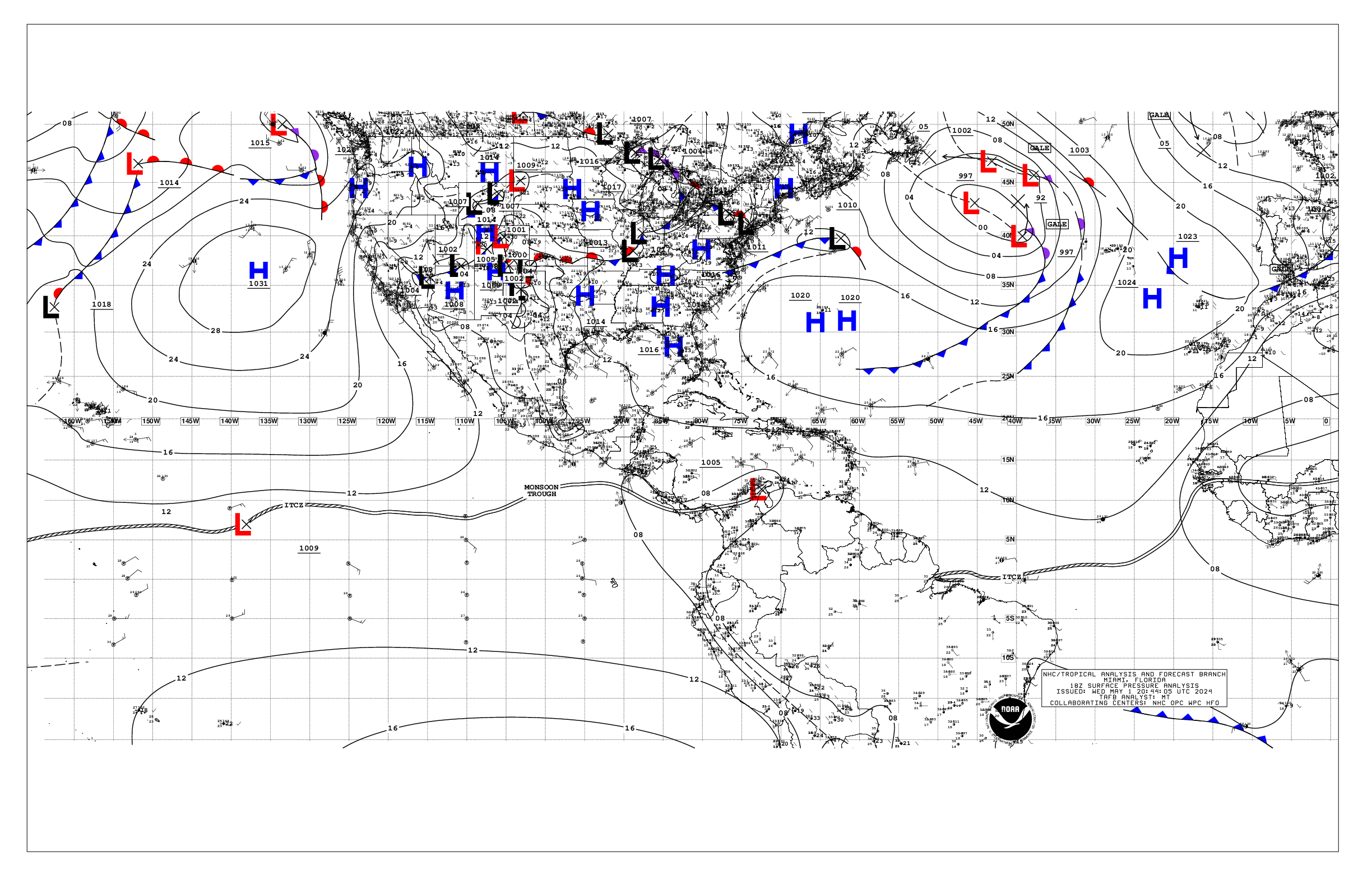
Based on 1800 UTC surface analysis and satellite imagery through
2145 UTC.

...SPECIAL FEATURES...Corrected

Recently downgraded Tropical Storm Vance is centered near 14.9N
104.2W, or about 270 nm WSW of Acapulco, Mexico  at 25/2100 UTC,
moving north-northwest at 6 kt. Estimated minimum central pressure
is 994 mb. Maximum sustained wind speed is 60 kt with gusts to 75
kt. Vertical wind shear and relatively dry mid-level air are
negatively impacting Vance's structure. satellite imagery shows
numerous moderate to isolated strong convection from 15N to 17N
between 103W and 106W. Scattered moderate convection is within 30 nm
of a line from 14N103W to 14N104W and to 14N106W. A northwestward to
west-northwestward motion at a slower forward speed is expected over
the next couple of days, followed by a turn toward the north around
the middle portion of the week. Vance is expected to produce 2 to 4
inches of rain, with isolated higher totals of 7 inches possible,
across Colima, Nayarit, and Sinaloa, along with western portions of
Michoacán, Jalisco, and Durango. This rainfall may produce flooding
and mudslides, especially in areas along steep terrain. Swell
generated by Vance will affect portions of the coast of southern and
southwestern Mexico during the next several days. These swells are
likely to cause life-threatening surf and rip current conditions.
Please consult products from your local weather office. Please read
the latest HIGH SEAS FORECAST issued by the National Hurricane
Center at website - https://www.nhc.noaa.gov/text/MIAHSFEP2.shtml
and the latest Vance NHC Forecast/Advisory and Public Advisory at
www.hurricanes.gov for more details.

Gulf of Tehuantepec Gale Warning: A tight pressure gradient over
Mexico from strong high pressure ridging is currently supporting
north to northeast winds of 25 to 30 kt in the Gulf of Tehuantepec
as seen in a recent Ascat data pass. These winds are expected to
pulse back up to gale-force tonight, then diminish to just below
gale-force by early Mon afternoon as the gradient slackens some.
Resultant seas will slowly subside through Tue. Please read the
latest High Seas Forecast issued by the National Hurricane Center at
website https://www.nhc.noaa.gov/text/MIAHSFEP2.shtml for further
details.

...INTERTROPICAL CONVERGENCE ZONE/MONSOON TROUGH...

The monsoon trough axis extends from the southwestern Caribbean
Sea near 12N76W southwestward to across central Panama, and
continues to 08N82W to 05N93W and to 09N99W. It resumes well
to the SW of of Vance at 08N113W to 06N123W to low pressure
near 08N131W 1011 mb and to 08N140W. Scattered moderate to
isolated strong convection is within 120 nm either side of the
trough between 93W-98W, and within 60 nm north of the trough
between 87W-93W. Scattered moderate convection is within 120 nm
north of the trough between 138W-140W, and also within 60 nm
south of the trough between 128W-130W.

...OFFSHORE WATERS WITHIN 250 NM OF MEXICO...

Please see the Special Features section above for information on
recently downgraded Tropical Storm Vance, and on a Gale warning
for the Gulf of Tehuantepec.

Aside from the Gulf of Tehuantepec and  Tropical Storm Vance, winds
are moderate or weaker as seen on recent ASCAT data passes. Seas are
moderate away from Vance and the Gulf of Tehuantepec region, except
slight in the Gulf of California away from the entrance.

For the forecast, recently downgraded Tropical Storm Vance will
maintain intensity as it moves to near 15.0N 104.8W late tonight,
then begin to weaken as it moves to near 15.4N 105.5W Mon
afternoon with maximum sustained winds 55 kt gusts 65 kt, to near
16.0N 106.2W late Mon night, to near 16.9N 106.6W Tue afternoon
with maximum sustained winds 45 kt gusts 55 kt, to near 17.7N
107.0W late Tue night and to near 19.0N 107.2W Wed afternoon. Vance
is forecast to become post-tropical as it moves near to near 21.0N
107.4W Thu afternoon with maximum sustained winds 40 kt gusts 50 kt.
Elsewhere, north to northeast near gale gap winds in the Gulf of
Tehuantepec are expected to pulse back up to gale-force tonight,
then diminish to just below gale- force by early Mon afternoon as
the gradient slackens some. Resultant seas will slowly subside
through Tue. These winds will pulse at fresh to strong speeds
through most of the week. Moderate to fresh winds will pulse
nearshore Baja California Norte through Tue evening. Moderate or
weaker winds along with moderate seas will prevail elsewhere away
from Vance and the Gulf of Tehuantepec, except mainly slight seas in
the Gulf of California.

...OFFSHORE WATERS WITHIN 250 NM OF CENTRAL AMERICA, COLOMBIA,
AND WITHIN 750 NM OF ECUADOR...

Moderate to fresh northeast to east winds and moderate seas are
over and downstream the Gulf of Papagayo. Winds are moderate or
weaker elsewhere with moderate seas, except slight seas nearshore
Colombia.

For the forecast, fresh northeast to east winds will pulse tonight
in the Papagayo region and again on Wed night, then be at gentle to
moderate speeds during the rest of the period. Otherwise, moderate
or weaker winds and moderate seas will continue elsewhere.

...REMAINDER OF THE AREA...

See Special Features section above for information on recently
downgraded Tropical Storm Vance.

High pressure covers the area generally north of about 18N and
west of 120W. Latest Ascat data passes captured an area of
fresh northeast trades from 14N to 19N between 120W and 130W.
Seas with these winds are about 5 to 6 ft. Winds are mainly
moderate or weaker elsewhere over this part of the discussion
area along with mostly moderate seas per latest altimeter data
passes.

For the forecast, Tropical Storm Vance will maintain intensity as it
moves to near 15.0N 104.8W late tonight, then begin to weaken as it
moves to near 15.4N 105.5W Mon afternoon with maximum sustained
winds 55 kt gusts 65 kt, to near 16.0N 106.2W late Mon night, to
near 16.9N 106.6W Tue afternoon with maximum sustained winds 45 kt
gusts 55 kt, to near 17.7N 107.0W late Tue night and to near 19.0N
107.2W Wed afternoon. Vance is forecast to become post- tropical as
it moves near to near 21.0N 107.4W Thu afternoon with maximum
sustained winds 40 kt gusts 50 kt. Elsewhere, moderate or weaker
winds and moderate seas will persist into around the middle part of
the week. Swell generated from a frontal system just northwest of
the discussion waters is expected to usher in rough seas to the SE
of 30N140W beginning tonight along with fresh southeast to south
winds over the far NW portion of the area. A tightening pressure
gradient related to the frontal system will boost these winds to
fresh to strong speeds on Tue, over the waters roughly north of
about 28N and west of 138W. Seas of 7 to 9 ft are expected with
these winds. Looking ahead, a new set of southerly swell is expected
to spread into the south-central waters starting late on Mon,
building seas to a rough state over the waters south of about 05N
between 105W and 130W by late Wed night. These seas are expected to
linger through at least Thu night.

$$
Aguirre


 NHC on Facebook
 NHC on X
 NHC on YouTube
 NHC Blog: